
LaRue County Criminal Court Records
A criminal court record is the case file maintained through the Kentucky Court of Justice after a charge is filed in court. In LaRue County, the local office for those records is the Office of Circuit Court Clerk, led by Emily N. Ernst. The court record can include the complaint or citation, charges, bond conditions, pretrial orders, indictment or information, plea, hearings, disposition, sentencing order, probation conditions, costs, and later post-judgment activity.
District Court starts many criminal matters in LaRue County. It handles misdemeanors, violations, traffic offenses, arraignments, felony preliminary matters, and related lower-court events. Circuit Court handles felonies and capital offenses. A felony may therefore have docket events in District Court before the case reaches Circuit Court. For a closer look at the charge itself, use LaRue County arrest records and court charges; for every case category, use LaRue County court records.
Search LaRue County Criminal Court Records
The main public lookup path is Kentucky CourtNet. The search can help locate a defendant's public case number, court level, charge or case category, docket activity, court date, and disposition where public access is allowed. The court-date search is often better for checking arraignments, preliminary hearings, criminal motion dates, traffic-related criminal dates, and future appearances.
- Open Kentucky CourtNet and search by defendant name or case number.
- Select LaRue County when the county filter appears.
- Use court or case-type filters to separate District Court misdemeanor and preliminary matters from Circuit Court felony records.
- Review docket entries for arraignment, hearings, motions, plea, disposition, sentencing, and failure-to-appear events.
- Request certified copies, older files, or documents not shown online from the LaRue County Circuit Court Clerk.
Kentucky State Police background checks are a separate criminal-history route. They are not the same as the LaRue County criminal court case file. Kentucky VINE can help with custody notification, but it is not the prosecutor's file or the clerk's court record.
LaRue County Criminal Case Flow
Criminal court records grow in stages. The first public court event may be a citation, complaint, arrest warrant, summons, or preliminary appearance. District Court may handle arraignment and probable-cause issues for felonies before a Circuit Court felony case is opened. Misdemeanor and traffic-criminal cases may stay in District Court through disposition.
Case flow: Charges Filed › Arraignment › Pretrial / Motions › Plea or Trial › Disposition › Sentencing
| Stage | What Happens |
|---|---|
| Charges Filed | A complaint, citation, indictment, information, or warrant starts the court charge record. |
| Arraignment | The defendant appears, charges are addressed, and bond or release conditions may be reviewed. |
| Pretrial / Motions | The docket can show hearings, continuances, discovery disputes, suppression motions, and plea talks. |
| Plea or Trial | The case may resolve by guilty plea, dismissal, acquittal, or trial verdict. |
| Disposition | The court enters the charge or case outcome, such as guilty, dismissed, amended, or acquitted. |
| Sentencing | The record may list jail, probation, fines, costs, restitution, conditions, or other orders. |
What LaRue Criminal Court Records Show
A LaRue County criminal court record is read field by field. A charge entry alone does not prove guilt. The useful fields are the court level, charge description, statute, count, docket history, plea, disposition, sentence, and whether the case moved between District Court and Circuit Court. Online results may not include document images, so the Circuit Court Clerk is the right source for certified criminal copies.
| Field | What It Shows |
|---|---|
| Case Number | The assigned Kentucky case identifier for the criminal court file. |
| Defendant | The person charged in the criminal case. |
| Court | LaRue District Court for misdemeanors, traffic, and felony preliminary matters, or LaRue Circuit Court for felonies. |
| Charges | Offense name, statute reference, count, severity, and amendments when public and entered. |
| Bond / Release | Cash bond, surety bond, own-recognizance release, or conditions when shown. |
| Docket Entries | Arraignment, preliminary hearing, indictment, motions, continuances, plea, trial, dismissal, and bench warrant entries. |
| Plea | The defendant's formal response or plea agreement event if recorded. |
| Disposition | The outcome of each charge or the case as entered by the court. |
| Sentence | Jail, probation, fines, costs, restitution, or other court-ordered terms. |
Charges vs Convictions
A charge is an accusation. A conviction is an outcome after a guilty plea, verdict, or other finding that establishes guilt. LaRue County criminal court records may show charges that were dismissed, amended, reduced, or resolved through a plea. Treat the disposition field as the key field when deciding what happened to each count.
| Charge | Conviction | |
|---|---|---|
| Meaning | An alleged offense filed in court. | A finding or plea of guilt entered by the court. |
| Record Stage | Appears early and may change. | Appears after plea, verdict, or judgment. |
| Risk of Misreading | May be dropped, dismissed, or amended. | Still should be checked against sentence and expungement status. |
| Where to Look | Charge line and docket entries. | Disposition, judgment, and sentencing entries. |
Public Access to LaRue Criminal Records
Public access to criminal court records in LaRue County runs through Kentucky Court of Justice systems and the Circuit Court Clerk. The Kentucky Open Records Act provides a broad public-record framework through KRS 61.870 and KRS 61.872, but criminal case copies and certified records are handled through court channels. Online lookup is not a certified copy.
Criminal history checks and court case records serve different purposes. A Kentucky State Police background check may report criminal-history information under state procedures. A LaRue County criminal court record shows the court case activity itself. Employers, landlords, insurers, and other regulated users should not treat casual case lookup as a consumer report.
Important: Public case lookup is not an FCRA consumer report and should be verified with the originating court.
Sealed vs Expunged Records
Kentucky law gives some people a way to clear or restrict criminal records, but eligibility depends on the charge, outcome, waiting period, and statute. KRS 431.073 governs many felony and misdemeanor expungement paths. KRS 431.076 addresses expungement after acquittal or dismissal. A person should identify the case number, court, charge, and disposition before using Kentucky Court of Justice expungement forms.
The KRS 431.073 expungement statute is one Kentucky source for determining whether a conviction record can be removed from public access.
| Sealed | Expunged | |
|---|---|---|
| Public Visibility | Hidden or limited by court order or law. | Removed from public access or treated under the expungement order. |
| Common Trigger | Confidential case type, protective order, or court sealing order. | Qualifying dismissal, acquittal, misdemeanor, or felony under Kentucky expungement law. |
| Access Path | Authorized party, attorney, agency, or court order. | Follow the granted expungement order and statutory limits. |
| What to Verify | Whether only part of the file is restricted. | Whether all agencies updated access after the order. |
Restricted LaRue Criminal Court Records
Not every criminal-related file is open to the public. Juvenile matters are restricted under KRS 610.340. Adoption records, which can appear in Circuit or Family Court contexts, are confidential under KRS 199.570. Mental-health proceedings, protected addresses, victim details, sealed warrants, and expunged criminal cases may also be shielded or redacted.
The KRS 610.340 juvenile court confidentiality source explains a major limit on public criminal-record searches.
Juvenile confidentiality is a key limit on any public criminal-court search in LaRue County.
The KRS 199.570 adoption confidentiality statute is another Kentucky court-record confidentiality source.
Adoption confidentiality is separate from criminal procedure, but it shows how Kentucky restricts sensitive court files even when a case is in a trial court.
Prosecutor and Defense Context
Kentucky does not use the District Attorney title. Felony prosecutions in Circuit Court are generally handled by the Commonwealth's Attorney. Misdemeanors, traffic offenses, and many District Court matters are commonly handled by the County Attorney. The research did not verify current local prosecutor names from official sources, so the criminal court records page should focus on the court record and the court clerk rather than naming unverified prosecutor staff.
People who cannot afford counsel generally request appointment through the court process at or after first appearance or arraignment. Kentucky's public-defense system is the Department of Public Advocacy. Prosecutor files, defense files, police reports, jail booking records, and Kentucky State Police background checks are all separate from the LaRue County criminal court case file.
For federal criminal filings, the U.S. District Court for the Western District of Kentucky is the trial-court source outside LaRue County state court.
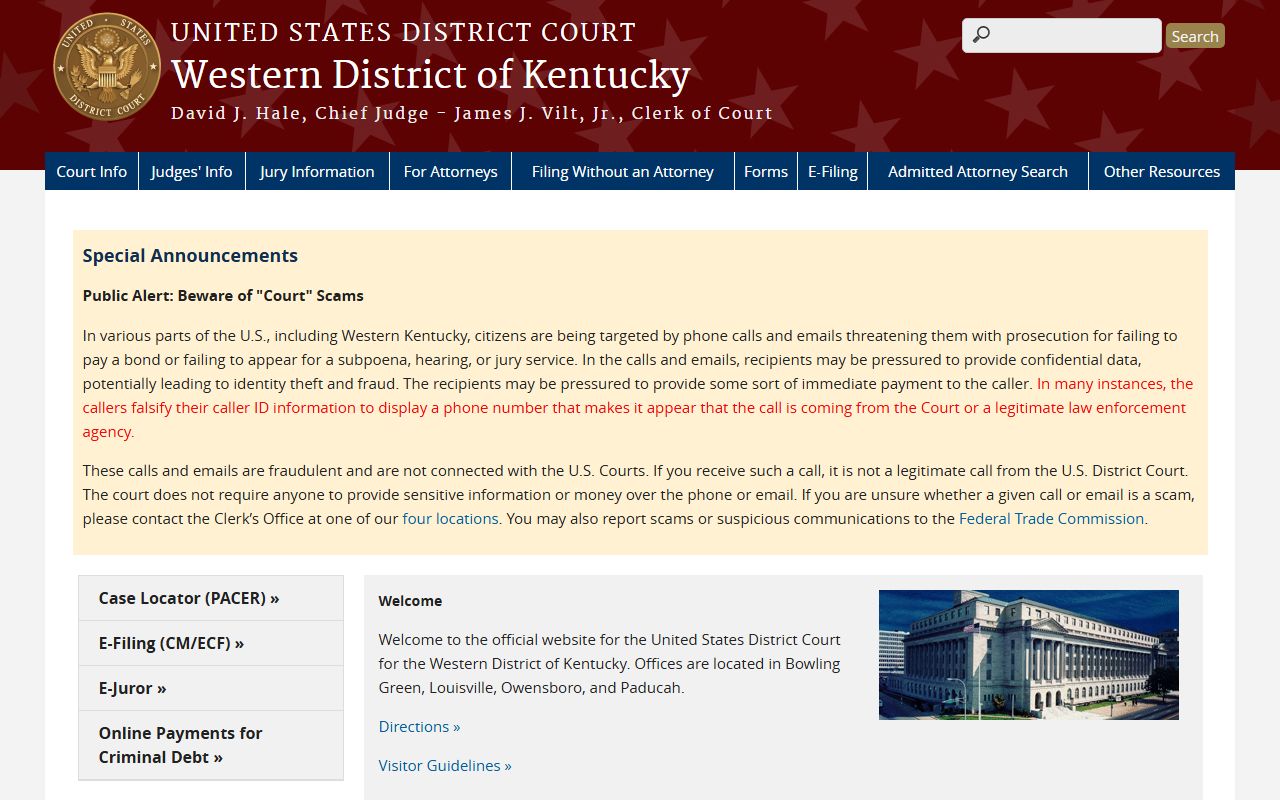
Federal criminal cases are not filed with the LaRue County Circuit Court Clerk, even when the person or event has a local connection.
Request Criminal Court Copies
For certified copies, older criminal files, records not shown online, or document-level access, contact the Office of Circuit Court Clerk at the LaRue County Courthouse Annex, 209 W. High St., P.O. Box 191, Hodgenville, KY 42748. The phone number is 270-358-3421 and the fax number is 270-358-3731. Public counter hours are Monday, Tuesday, Thursday, and Friday 8 a.m.-4 p.m., with Wednesday 8 a.m.-4 p.m. and closed noon-1 p.m.
Bring or provide the case number if possible. If the case number is unknown, provide the defendant name, approximate date, court level, charge, and any known hearing date. Older records may be in the clerk's office, at a record facility, or destroyed under retention schedules.